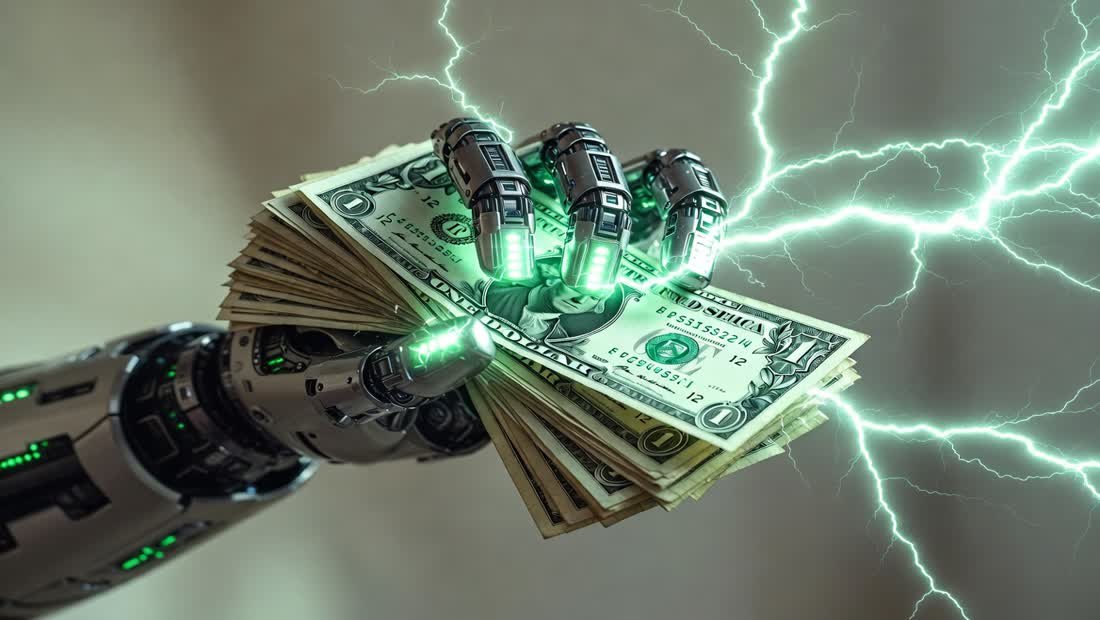
For most of the modern economic history, financial instruments represented a nation's productive capacity. Economy in the 20th century rested on the financial instruments first on gold and later the US Dollar. In the 21st century these currencies started to be replaced by the electricity production. Especially in AI data centers economic activities are produced by electricity. Therefore, gold and the dollar started to lose their influence in describing nations' economic development levels. Instead electricity production (kw-hr) has started to emerge as the new standard for this purpose.
Over the last 55 plus years we witnessed the global economy convert its basis from the classical financial instruments to the petrodollar. It was the mid-1970s when the US made agreements with the Organization of the Petroleum Exporting Countries (OPEC) which stabilized the crude oil price in petrodollars. This system created structural global demand for the American currency and cemented financial dominance for half a century. A similar dynamic is now plausible in the age of AI which might convert Petrodollar to Electrodollar. (*)
Capital flowing into AI infrastructure, especially for data centers, is expected to reach $6.7 trillion by 2030, according to a McKinsey’s scenario. The International Energy Agency (IEA) estimates AI data centers will consume 945 terawatt-hours of electricity by 2030 in the US, which is more than double the present level. In other words, in the United States alone, data centers are expected to account for 8.9 percent of total electricity demand by 2030.
This demand will cause all services to be priced according to the energy required for their production. This reprices everything based on its embedded energy content. A data center’s valuation will be judged less by square footage than by gigawatt-hours reliably delivered.
Oil-rich nations are converting their hydrocarbon energy economies into power and intelligence.
In a recent interview in Economics, Elon Musk (**) predicted that by 2036 money will be irrelevant since AI and robots will create more goods and services than humans need globally. He suggested that the next big entrepreneurial activities should focus on making solar energy available from space, where there are constant, uninterrupted sources of solar energy. While this may sound too futuristic and unreal one Gen Z, entrepreneur must consider it seriously.
In net, nations that produce large amounts of electricity will control intelligence and thus become the superpowers of the 21st century.
———-
(*) nationalinterest.org/blog/energy-world/energy-as-currency-the-economics-of-power-in-the-age-of-ai